
The story of printing is, in many ways, the story of human civilization itself. From its earliest origins in ancient China—where the art of seal carving, stone rubbing, and woodblock techniques gradually converged into sophisticated printing practices—the written and visual image has been a cornerstone of cultural transmission. By the early Tang Dynasty (circa 600 AD), carved wooden blocks were already producing reproducible texts and images. Then, in 1041 during the Song Dynasty, Bi Sheng invented clay movable type, establishing the world’s first known system of reusable typography. Centuries later, Johannes Gutenberg’s work in the mid-15th century—particularly his screw-type wooden hand press and the subsequent spread of movable-type printing across Europe after 1477—cemented the mechanical foundations of modern print culture.
For hundreds of years, traditional methods such as letterpress (where raised surfaces carry ink), gravure (where recessed cells hold ink), offset lithography (relying on the mutual repulsion of water and oil to transfer images via rubber blanket), and screen printing (forcing ink through a mesh stencil) dominated the landscape. These technologies could decorate or mark a vast array of substrates: paper, textiles, metal plates, plastics, leather, wood, glass, and ceramics. Modern conventional presses integrated complex mechanisms—plate mounting, inking, impression, and paper transport (including folding)—to replicate originals with fidelity. Yet they also carried inherent limitations: the need for physical plates, lengthy setup times, minimum run lengths dictated by economics, and constraints on customization.
The advent of digital printing changed the equation entirely. By transmitting graphic information directly from prepress systems to the print engine over networks, digital technology removes film, plate-making, and mechanical makeready from the production chain. Every impression becomes variable; information can be 100% personalized; output is no longer bound by temporal or spatial constraints. Among the imaging architectures available—electrostatic, inkjet, electrocoagulation, thermal transfer, and magnetic recording—electrostatic and inkjet dominate today’s market. It is precisely within the electrostatic, toner-based domain that Vorey has positioned its flagship solution: the V3 Digital Toner Printer.
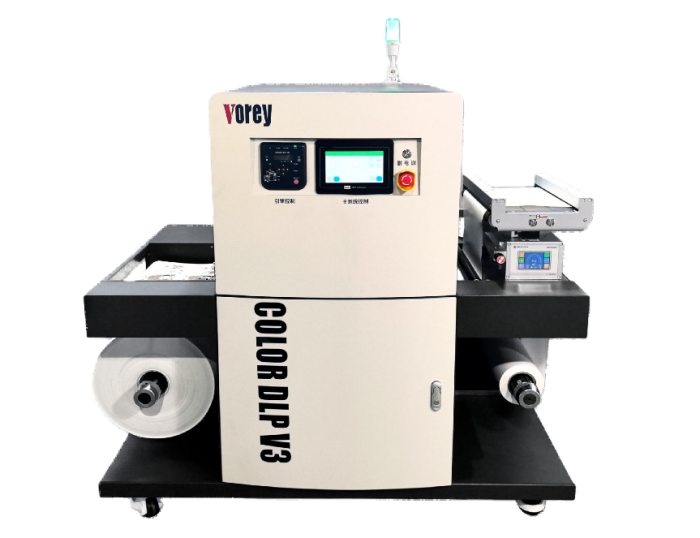
The Vorey V3 is not merely an incremental upgrade; it is a purpose-built production system designed to meet the unpredictable, fast-cycle demands of contemporary commercial print. At its core lies a 4-color (CMYK) LED imaging engine that achieves a native print resolution of 1200 × 2400 dpi, ensuring fine detail and smooth tonal transitions rivaling traditional processes. A dedicated 933 MHz printer processor drives the imaging pipeline, sustaining a print speed of 7.26 meters per minute while maintaining consistent output quality.
Physically, the V3 handles media up to 320 mm in width (with a maximum print width of 304 mm and a minimum of 210 mm), and supports print lengths up to 1,200 mm. Substrate flexibility is extensive: from 60–280 g/m² paper, high-gloss and matte papers, to PET, PP, PE, GHS films—materials rigorously tested under controlled conditions. (As with any professional device, untested media should be evaluated before production.) The feeding system features a maximum roll diameter of 450 mm, a 76.2 mm core diameter, and supports rolls up to 47.2 kg, incorporating auto-tension adjustment, media-table connection, processing, and feeding-adjustment systems for stable, unattended operation. Print modes include continuous and second-track options, while data connectivity via Standard 10BASE-T / 100BASE-TX ports ensures seamless integration into digital workflows.
Consumables are engineered for productivity. CMYK toner yields are rated at approximately 18,500 A4 sheets (5% coverage) for color and 26,000 A4 sheets for black, following ISO/IEC 19798 guidelines; the CMYK drum unit is rated for 100,000 cycles (subject to operating conditions, media, and print direction). Despite its robust throughput, the print engine weighs 423 kg and occupies a footprint of 1,400 × 855 × 1,400 mm (V3 configuration). Environmental requirements are modest: 20–23 °C ambient temperature and 45–55% relative humidity. Power configurations support 110–127 VAC or 220–240 VAC (50/60 Hz, 2800 W), with consumption rates of 75 W (sleep), 100 W (waiting), and 1,100 W (running). Recommended monthly volume is up to 2,000 m², and the system is backed by a 1-year warranty (excluding high-consumable parts). On the computing side, the prepress interface recommends an Intel Xeon E5-1650 or Core i7-3930K-class CPU, 12 GB RAM (minimum), 150 GB SATA HDD (10K/15K RPM), and Windows 7 Professional or ultimate 64-bit.
What distinguishes the Vorey V3 is how it preserves the essential promise of printing—accurate, repeatable, and beautiful reproduction of text and image—while discarding the bottlenecks of analog setup. Where traditional letterpress demanded raised type, gravure required etched cylinders, and offset needed water-ink balance and plate chemistry, the V3 begins with a digital file and ends with a finished print in under 28 seconds of preparation time. There is no plate to mount, no press proof to approve beyond the soft-proof, and no economic penalty for printing one copy or ten thousand unique copies. This makes the V3 indispensable for rush jobs, variable-data campaigns, and on-demand publishing—applications that conventional methods struggle to address profitably.
In essence, Vorey’s V3 digital toner printer carries forward the legacy of Bi Sheng and Gutenberg into an era defined by instantaneous information exchange. It honors the past by delivering the quality expected of professional print, yet fully embraces the flexibility, speed, and personalization that define modern communication. For print service providers navigating an industry where agility is as vital as image quality, the Vorey V3 stands as a powerful testament to how far the technology of reproduction has come—and where it is headed next.

 0574-87476008
 English